 The benchmark-to-production gap: clean labs, messy reality
TL;DR
- Frontier models score 80%+ on narrow benchmarks but drop to 2–24% success on real-world long-horizon tasks across six independent evaluations (LongCLI-Bench, ALE, TheAgentCompany, HORIZON, DELEGATE-52, Zylos Research).
- The gap isn't model capability. Agents lose state across long sequences, tool calls fail unpredictably, and there's no recovery mechanism. These are orchestration problems.
- One domain is safe. Microsoft's DELEGATE-52 found only Python coding meets the 98% content-preservation threshold across 52 professional domains—every other domain degrades.
- 95% per-step accuracy compounds to 36% end-to-end on a 20-step workflow. We measure the wrong thing and call agents "production-ready."
- Pockets of success exist—but only in narrow, well-engineered domains (support triage, routing, summarization). Open-ended workflows remain unsolved.
Frontier models score above 80% on benchmarks. Then engineers deploy them on real workflows and watch them fail.
This isn't a new complaint. What's new is that we now have six independent benchmarks—each testing agents on realistic, long-horizon tasks—all showing the same collapse. The numbers range from 2.6% to 24% success. The failure modes are consistent. And the cause, according to practitioners and researchers alike, isn't model capability. It's architecture.
Here's what the data actually says.
The Benchmark vs. Reality Chasm
Current benchmarks measure single-turn accuracy on curated tasks. Production workflows are multi-step, open-ended, stateful, and adversarial. That mismatch is where pass rates collapse from 80% in labs to single digits in the wild.
Microsoft researchers built DELEGATE-52 to measure exactly this gap. The benchmark spans 52 professional domains—accounting, coding, crystallography, music notation—and runs agents through 20 interaction rounds on document workflows. Results, reported in their preprint "LLMs Corrupt Your Documents When You Delegate" (2026), are stark: frontier models including Gemini 3.1 Pro, Claude 4.6 Opus, and GPT 5.4 lose an average of 25% of document content over 20 interactions. Across all tested models, average degradation reaches 50% content loss by round 20.
The failures aren't a slow, predictable drift. They appear as sudden catastrophes—benchmark scores dropping 10–30 points in a single round. And in over 80% of model-domain combinations, scores fell to 80% or lower, which the researchers classify as severe corruption.
Only one domain passed the readiness threshold of 98% content preservation: Python coding.
Compare that to a single-task benchmark where the same frontier models score 80%+. The models haven't changed. The task length has.
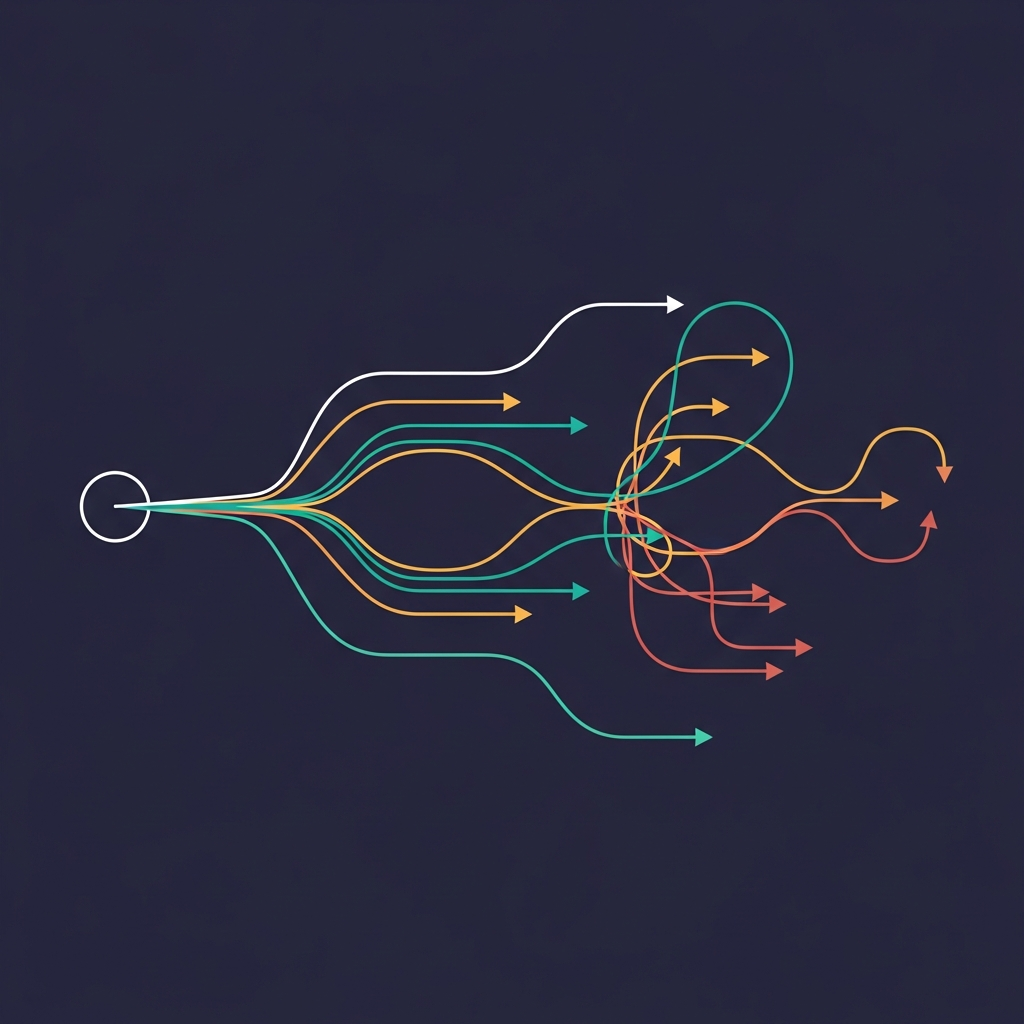 State drift across multi-step agent workflows
What 1,000+ Real-World Long-Horizon Tasks Tell Us
Six independent research efforts have now tested agents on realistic, long-horizon tasks. Every one shows the same pattern.
LongCLI-Bench (arXiv, 2026) curated 20 long-horizon tasks from over 1,000 real computer-science assignments and software workflows. Task types: from-scratch builds, feature additions, bug fixes, refactoring. State-of-the-art agents achieved pass rates below 20%. Step-level analysis showed most tasks stall before reaching 30% completion, with critical failures concentrated in early stages.
ALE (Agents' Last Exam) set the bar at economically valuable computer-use workflows—not curated demos. On the hardest tier, mainstream agent configurations averaged a 2.6% full pass rate (arXiv, 2026).
TheAgentCompany (Carnegie Mellon, 2025) simulated a company environment. Claude 3.5 Sonnet, the best performer, completed 24% of tasks (34.4% with partial credit). Google Gemini 2.0 Flash: 11.4%. OpenAI GPT-4o: 8.6%.
HORIZON (2026) tested state-of-the-art models on 3,100+ real-world multi-step navigation trajectories. Benchmark co-author Tejaswi Sinha summarized the finding on LinkedIn: 90% of AI agents that pass testing fail in production. Two-thirds fail on routine multi-step tasks—not adversarial inputs.
Zylos Research (2026) ran frontier models on real-world long-horizon tasks. The best first-attempt completion rate was 24%, implying a 76% failure rate even for the strongest configurations.
Odysseys (arXiv, 2026) introduced 200 long-horizon web tasks from real browsing sessions. The conclusion: "current agents struggle with core aspects of long-horizon web navigation"—long-horizon web interaction remains unsolved.
The pattern is consistent across independent research groups, different task domains, and different evaluation criteria. The benchmarks measuring this don't share methodology—they just share findings.
Why Agents Collapse on Long Horizons (Orchestration, Not Capability)
The gap isn't raw model capability. It's orchestration: agents lose state over long sequences, tool calls fail unpredictably, context drifts, and there's no recovery mechanism. These are engineering problems, not intelligence problems.
An empirical study published in 2025—"What Challenges Do Developers Face in AI Agent Systems?"—mined real Stack Overflow questions and GitHub issues to find where agents actually break. Five failure families emerged: environment and dependency management, retrieval and memory, orchestration and control, interaction contracts between models and tools, and runtime reliability. Orchestration, memory, and RAG challenges together account for over 50% of difficult, long-unsolved problems on both platforms.
GitHub's own engineering team published a technical breakdown of why multi-agent systems fail in production, noting that "the moment agents begin handling related tasks—triaging issues, proposing changes, running checks, and opening pull requests—they start making implicit assumptions about state, ordering, and validation." Without explicit interfaces, "agents operating on shared state create unpredictable outcomes."
Zylos Research identified the 35-minute cliff: agent performance degrades sharply around this mark in long-running tasks. Their recommendation—don't let a single agent run continuously for an hour; delegate ten 10-minute tasks instead—reflects that continuous context is the enemy of reliability.
Civic's production analysis ("Why AI Agents Fail at Scale and How to Fix Them", 2026) traces the problem to four missing infrastructure primitives: persistent identity, governed access, durable memory, and deterministic policy enforcement. Remove any one, they argue, and agent autonomy collapses at scale.
The models are capable. The systems wrapping them aren't built for the task.
The Failure Taxonomy Existing Coverage Misses
Most articles list failure causes—governance, validation, observability—without quantifying them. One study does.
"Unveiling Pitfalls: Understanding Why AI-driven Code Agents Fail at GitHub Issue Resolution" (2025) broke down agent failures in real GitHub repositories into three categories: planning failures (42%), tool interaction failures (36%), and code context understanding failures (22%).
Planning failures mean agents struggle with issue understanding and effective execution plans. Tool interaction failures mean misuse of dev tools and APIs. Code context failures mean agents can't navigate repository structures and understand dependencies. Taken together: the bottleneck isn't code generation. It's context, integration, and validation.
A separate study of ~33,000 agent-authored GitHub pull requests found further nuance. Tasks related to documentation, CI updates, and build configuration had the highest merge success rates (~60–70%). Bug fixes and performance work had the lowest (~20–30%). Not-merged PRs touched more files, involved larger diffs, and failed CI/CD pipelines at 2–3× the rate of merged ones.
That's counterintuitive. Agents are worst at the tasks everyone most wants them to do.
Pockets of Real-World Success (But Narrowly Scoped)
Agents do work at scale—in narrow, well-engineered domains. Customer support triage. IT ticket routing. Internal knowledge summarization. These use cases share traits: bounded scope, stable tools, structured data, and human oversight at key decision points.
Why do narrow domains succeed? Fewer state variables, deterministic tool contracts, and clear validation criteria. An agent routing a ticket has a fixed output space. An agent running R&D exploration doesn't.
The implication matters for how you interpret the benchmark numbers. A 24% success rate on TheAgentCompany isn't evidence that agents are broken—it's evidence that the specific definition of "production-ready" has to include the workflow type. Gartner forecasts that up to 40% of agentic initiatives may fail by 2027 due to scope creep and integration costs (Forbes Business Council, 2026). The organizations that avoid that failure pattern tend to be the ones who resist the temptation to expand scope before they've validated narrow automation.
Open-ended workflows—R&D, strategy, multi-domain problem-solving—remain a different category. Not because the models lack intelligence, but because the state space is unlimited, tool failures cascade unpredictably, and there's no clear success criterion an agent can validate against.
What Practitioners Actually Report
Engineers who've deployed agents at scale aren't surprised by these numbers. They've been living the consequences.
GitHub's engineering team frames it clearly: failures in multi-agent production systems trace to "missing structural components" developers overlook when scaling from single-agent demos to multi-agent architectures. Agents make implicit assumptions about state. Without typed schemas and explicit contracts, a field name change breaks entire workflows downstream.
The Stack Overflow and GitHub empirical study found a revealing pattern: the topics developers find most challenging—RAG engineering, document embeddings, and orchestration—take longer to resolve and often go unanswered, even though they're less frequently discussed. The hard problems are also the quiet ones, because practitioners don't know how to ask them.
From a GitHub PR analysis commentary by Sachin Kamdar: "Most of them got rejected. The #1 reason? Humans didn't even look at them." And when they did: "agents are worst at the thing everyone wants them to do. Bug-fix tasks had the lowest merge acceptance rate of any task type."
The post-mortem pattern is consistent across teams: when agents fail, the root cause is almost never "the model reasoned incorrectly." It's "we didn't isolate state properly" or "tool output format changed and nobody caught it."
 The operational reality: agents fail on context, integration, and validation—not code generation
The Measurement Gap That Enables Overconfidence
We claim agents are "production-ready" based on single-turn accuracy. But production demands multi-turn coherence, failure recovery, and resource budgets. Those dimensions are rarely measured at scale.
The math is uncomfortable. If an agent has 95% per-step accuracy on a 20-step workflow, end-to-end success is only 36% (0.95²⁰ ≈ 0.358). We optimize for the per-step number and publish it in papers. We don't publish the compounding curve.
DELEGATE-52 makes the same point differently: tests that run only 2 interaction rounds miss the failure modes entirely. Short tests produce clean numbers. Long horizons expose the real distribution.
The missing metrics are obvious once you name them: end-to-end workflow success rate (what percentage of 10-step tasks complete without human intervention?), failure recovery rate, cost per successful outcome including retries, and context-window survival—how long before output degrades? None of these are routinely published. We ship agents with invisible failure rates because we measure the wrong thing.
So What Changes?
The agents aren't broken. The way we measure and deploy them is. Three shifts matter.
Stop optimizing for single-task accuracy; measure end-to-end workflow success. A model that scores 95% per step and 36% end-to-end is a 36% model for your workflow. That's the number that matters.
Design agents as managed systems with state, identity, and policy—not as clever prompts. GitHub's framework for multi-agent workflows—typed schemas, action constraints, explicit interfaces between agents—isn't optional complexity. It's the difference between a demo and a deployment. Civic's four primitives (persistent identity, governed access, durable memory, deterministic policy enforcement) exist in every mature software system. Agents need them too.
Know your domain before claiming readiness. Is this workflow narrow, deterministic, and well-observed? Or is it open-ended, multi-domain, and stateful over hours? The former can ship as autonomous agents today. The latter needs human gates, explicit checkpoints, and honest expectations about what "automated" means. For teams comparing model behavior across their real workflows—rather than relying on published benchmarks—Mesh API's compare endpoint lets you run identical prompts across frontier models and measure what actually matters for your task.
88% of agentic AI projects fail to reach production or deliver promised business value (Digital Applied, analysis of 2024–2025 deployments). The projects that succeed tend to be the ones where engineers asked "is this workflow appropriate for autonomous agents?" before they asked "which model should we use?"
FAQ
Q: Do frontier models really solve most benchmark tasks?
Yes—Claude, GPT-4, and Gemini score 80%+ on narrow benchmarks (MMLU, coding contests). But those benchmarks measure single-turn tasks. Real workflows are multi-step. When tested on sequences of 10+ steps (LongCLI-Bench, ALE, DELEGATE-52), success drops to 2–24%. The model is capable; the architecture isn't designed for long horizons.
Q: Isn't this just a tool-calling problem? If we fix tool schemas, won't agents improve?
Tool contracts help—GitHub's MCP framework demonstrates this—but they address roughly one-fifth of the failure surface. The larger issues are state coherence across steps (agents lose track of early constraints), context-window limits that force forgetting, no checkpointing for long tasks, and no recovery from partial failures. Fixing tool contracts alone moves the needle from 2% toward maybe 5–8%.
Q: What percentage of agent projects actually fail in production?
About 88% of agentic AI projects fail to reach production or fail to deliver promised business value once they do (Digital Applied, analysis of 2024–2025 deployments). Of agents that reach production, failure rates on multi-step tasks range from 70–95% depending on workflow complexity and engineering rigor.
Q: If engineering fixes so much, why isn't anyone shipping production-grade agents at scale?
A few teams have—in narrow domains (support triage, ticket routing, summarization). The engineering cost to support open-ended, multi-domain workflows is high, and failure modes are hard to predict. That's why most production agents are co-pilot designs or narrow specialists, not fully autonomous systems.
Q: Should we stop building agents?
No—but scope carefully. Agents are excellent at narrow, deterministic, well-observed tasks. Use them there first. For open-ended workflows (R&D, strategy, exploration), treat agents as co-pilots rather than autonomous actors, and build in explicit human checkpoints before the 35-minute cliff hits.